Discussion 2: Environment Diagrams, Higher-Order Functions🖨️
Attendance
Your TA will come around during discussion to check you in. You can start on the worksheet before being checked in; you don't need to wait for your TA to get started.
If you didn't attend for a good reason (such as being sick), fill out this form (within 2 weeks of your discussion): attendance form
If you get stuck, there are walkthrough videos (@berkeley.edu login to YouTube required).
Getting Started
Say your name and a city (or place) that you like, which is not Berkeley and is not where you have lived. Feel free to share why you like it.
VERY IMPORTANT: In this discussion, don't run any Python code until your whole group is sure that the answer is right. Your goal should be to have all answers right the first time! Figure things out and check your work by thinking about what your code will do and discussing with others. Not sure? Talk to your group or a TA! (You won't get to run Python during the midterm, so get used to solving problems without it now.)
Q1: Warm Up
What is the value of result after executing
result = (lambda x: 2 * (lambda x: 3)(4) * x)(5)? Talk about it with your
whole group and make sure you all agree before anybody checks the answer.
Call Expressions
Q2: Teamwork
Draw an environment diagram for the code below. You can use paper or a tablet or the whiteboard. Talk to your group about how you are going to draw it, then go through each step together.
def team(work):
    return t(work) - 1
def dream(work, s):
    if work(s-2):
        t = not s
    return not t
work, t = 3, abs
team = dream(team, work + 1) and t
Then step through the environment diagram in Python Tutor (opens a new tab) to check your work.
Here's a blank diagram in case you're using a tablet.
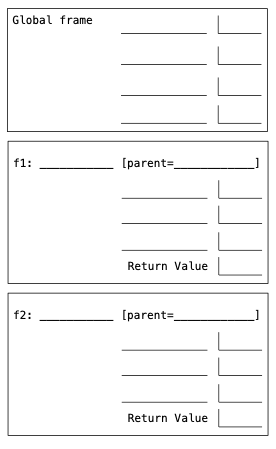
If you have questions, ask them instead of just looking up the answer! First ask your group, and then your TA.
Higher-Order Functions
Remember the problem-solving approach from last discussion; it works just as well for implementing higher-order functions.
- Pick an example input and corresponding output. (This time it might be a function.)
- Describe a process (in English) that computes the output from the input using simple steps.
- Figure out what additional names you'll need to carry out this process.
- Implement the process in code using those additional names.
- Determine whether the implementation really works on your original example.
- Determine whether the implementation really works on other examples. (If not, you might need to revise step 2.)
Q3: Make Keeper
Implement make_keeper, which takes a positive integer n and returns a
function f that takes as its argument another one-argument function cond.
When f is called on cond, it prints out the integers from 1 to n
(including n) for which cond returns a true value when called on each of
those integers. Each integer is printed on a separate line.
def make_keeper(n):
    """Returns a function that takes one parameter cond and prints
    out all integers 1..i..n where calling cond(i) returns True.

    >>> def is_even(x): # Even numbers have remainder 0 when divided by 2.
    ...     return x % 2 == 0
    >>> make_keeper(5)(is_even)
    2
    4
    >>> make_keeper(5)(lambda x: True)
    1
    2
    3
    4
    5
    >>> make_keeper(5)(lambda x: False)  # Nothing is printed
    """
    "*** YOUR CODE HERE ***"
No peeking! First try to implement it without the hint.
Hint
To return a function f, include def f(cond): as the first line of the
implementation and return f as the last. The f function should introduce i = 1 in order to loop through all integers, calling cond(i) to determine
whether cond returns true for each integer.
Before you press Verify, check your work just by thinking!
Once your group has converged on a solution, now it's time to practice your ability to describe your own code. A good description is like a good program: concise and accurate. Nominate someone to describe how your solution works and have them present to the group. If you want feedback, you can also present to your TA.
Q4: Digit Finder
Implement find_digit, which takes in a positive integer k and returns a
function that takes in a positive integer x and returns the kth digit from
the right of x. If x has fewer than k digits, it returns 0.
For example, in the number 4567, 7 is the 1st digit from the right, 6 is the 2nd digit from the right, and the 5th digit from the right is 0 (since there are only 4 digits).
Important: You may not use strings or indexing for this problem. Try to solve
this problem using only one line as a single lambda expression, since lambdas can only
contain one expression (no loops/assignments).
Tip: Use floor dividing by a power of 10 to get rid of the rightmost digits.
def find_digit(k):
    """Returns a function that returns the kth digit of x.

    >>> find_digit(2)(3456)
    5
    >>> find_digit(2)(5678)
    7
    >>> find_digit(1)(10)
    0
    >>> find_digit(4)(789)
    0
    """
    assert k > 0
    "*** YOUR CODE HERE ***"
Hint
First remove all of the digits after digit k, at which point digit k will
be the last digit.
Q5: Match Maker
Implement match_k, which takes in an integer k and returns a function
that takes in a variable x and returns True if all the digits in x that
are k apart are the same.
For example, match_k(2) returns a one argument function that takes in x
and checks if digits that are 2 away in x are the same.
match_k(2)(1010) has the value of x = 1010 and digits 1, 0, 1, 0 going
from left to right. 1 == 1 and 0 == 0, so the match_k(2)(1010) results
in True.
match_k(2)(2010) has the value of x = 2010 and digits 2, 0, 1, 0 going
from left to right. 2 != 1 and 0 == 0, so the match_k(2)(2010) results
in False.
Important: You may not use strings or indexing for this problem.
You may call find_digit.
Tip: Floor dividing by powers of 10 gets rid of the rightmost digits.
def match_k(k):
    """Returns a function that checks if digits k apart match.

    >>> match_k(2)(1010)
    True
    >>> match_k(2)(2010)
    False
    >>> match_k(1)(1010)
    False
    >>> match_k(1)(1)
    True
    >>> match_k(1)(2111111111111111)
    False
    >>> match_k(3)(123123)
    True
    >>> match_k(2)(123123)
    False
    """
    def check(x):
        while x // (10 ** k) > 0:
            if ____________________________:
                return ____________________________
            x //= 10
        ____________________________
    ____________________________
Hint
In each iteration, compare the last digit with the one that is k positions
before it.
Optional Exam Review
Here are some recent Midterm 1 problems that are similar to the problems you just solved. If you have extra time, discuss them with your group. If you don't have enough time, you could schedule another meeting with your group before the midterm to go through these together.
Here's a good format for group exam review:
- First, everyone read the question but don't solve it yet.
- Second, see if anyone has any questions about what the problem is asking for.
- Third, let everyone work individually for five minutes or so to try to make progress on their own.
- Fourth, have the people who got stuck (which is ok!) explain what they tried.
- Fifth, give suggestions to the people who got stuck about what they might have tried to keep making progress.
- Finally, talk through potential solutions to the problem.
Avoid the temptation to look up the solution until your whole group is confident that you've reached a correct answer.
All past exams are here: cs61a.org/resources/
Q6: Which One
This question was Spring 2024 61A Midterm 1 Question 1(b).
What is displayed by the interactive Python interpreter after evaluating
which()(), given that the following code has been executed?
one = 1
def which():
    one = 3
    def this():
        return one
        return one + 1
    return this
    one = 4
Once your whole group agrees on an answer, step through it in Python Tutor (opens a new tab) to see the answer.
Q7: Choose Wisely
This question was Fall 2023 61A Midterm 1 Question 4(b). On the exam, the last two blanks were multiple choice. It is a typical problem that combines iteration and a higher-order function.
Definition: A digit test is a function that takes a non-negative integer
less than 10 and returns True or False.
Implement every, which takes a digit test t and returns a function digit
that takes a positive integer n. The digit function returns whether t
returns True for every digit of n.
def every(t):
    """Return a function of n that returns whether t returns True for every digit of n.

    >>> f = every(lambda d: d % 2 == 1)
    >>> f(37511)  # every digit is odd
    True
    >>> f(2023)   # Not every digit is odd
    False
    """
    def digit(n):
        assert n > 0
        while n:
            if ____________________________:
                ____________________________
            n = n // 10
        return ____________________________
    return ____________________________
Q8: Nice Dice
These two questions were Spring 2024 Midterm 1
Questions 4(b) and 4(c). On the exam, the blank in count_at_least was
multiple choice.
It is a typical problem that asks you to use a function that you just defined.
Fill in the blank of count_if, which takes a one-argument function f. It
returns a function that takes a positive integer n and returns the count of
its digits for which f returns a true value.
Then, fill in the blank of count_at_least, which takes a positive integer k.
It returns a function that takes a positive integer n and returns the count of
its digits that are greater than or equal to k.
def count_if(f):
    """Return a function that takes a positive integer n and returns
    the count of its digits for which f returns a true value.

    >>> is_three = lambda d: d == 3
    >>> count_threes = count_if(is_three)  # count_threes returns the number of threes in n
    >>> count_threes(431663334231)         # 3 appears 5 times
    5
    """
    def g(n):
        count = 0
        while n:
            if ____________________________:
                count += 1
            n = n // 10
        return count
    return g

def count_at_least(k):
    """Return a function that returns how many of the digits of its argument are at least k.

    >>> above_3 = count_at_least(3)  # above_3 returns the # of digits greater than or equal to 3
    >>> above_3(431663334231)
    9
    """
    return count_if(____________________________)