Discussion 4: Tree Recursion
IMPORTANT! Add your email address and then press "Join Group" above!
Attendance
Your TA will come around during discussion to check you in. You can start on the worksheet before being checked in; you don't need to wait for your TA to get started.
If you didn't attend for a good reason (such as being sick), fill out this form (within 2 weeks of your discussion): attendance form
If you get stuck, there are walkthrough videos (@berkeley.edu login to YouTube required).
Getting Started
Say your name and your favorite tree (a particular tree or a kind of tree) in honor of today's topic: tree recursion.
Definition: Tree recursive functions are functions that call themselves more than once.
Recursion takes practice. Please don't get discouraged if you're struggling to write recursive functions. Instead, every time you do solve one (even with help or in a group), make note of what you had to realize to make progress. Students improve through practice and reflection.
VERY IMPORTANT: In this discussion, don't check your answers until your whole group is sure that the answer is right. Figure things out and check your work by thinking about what your code will do. Your goal should be to have all answers right the first time! If you need help, ask.
Tree Recursion
For the following questions, don't start trying to write code right away. Instead, start by describing the recursive case in words. Some examples:
- In
fibfrom Section 1.7 of the textbook, the recursive case is to add together the previous two Fibonacci numbers. - In
skip_factorialfrom Discussion 3 (Q2), the recursive case is to multiplynby the skip factorial ofn - 2. - In
count_partitionsfrom Section 1.7 of the textbook, the recursive case is to partitionn-musing parts up to sizemand to partitionnusing parts up to sizem-1.
Q1: Insect Combinatorics
An insect is inside an m by n grid. The insect starts at the bottom-left
corner (1, 1) and wants to end up at the top-right corner (m, n). The
insect can only move up or to the right. Write a function paths that takes
the height and width of a grid and returns the number of paths the insect can
take from the start to the end. (There is a closed-form
solution to this
problem, but try to answer it with recursion.)
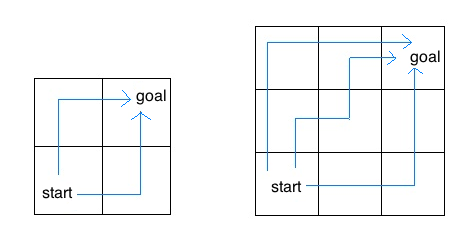
In the 2 by 2 grid, the insect has two paths from the start to the end. In
the 3 by 3 grid, the insect has six paths (only three are shown above).
Hint: What happens if the insect hits the upper or rightmost edge of the grid?
def paths(m: int, n: int) -> int:
    """Return the number of paths from one corner of an
    m by n grid to the opposite corner.

    >>> paths(2, 2)
    2
    >>> paths(5, 7)
    210
    >>> paths(117, 1)
    1
    >>> paths(1, 157)
    1
    """
Hint 1: Recursive Case (at the end)
Presentation Time: Once your group has converged on a solution, it's time to practice your ability to describe why your recursive case is correct. Nominate someone and have them present to the group for practice. If you want feedback, ask.
Tree Recursion with Lists
Some of you already know list operations that we haven't covered yet, such as
append. Don't use those today. All you need are list literals (e.g.,
[1, 2, 3]), item selection (e.g., s[0]), list addition (e.g.,
[1] + [2, 3]), len (e.g., len(s)), slicing (e.g., s[1:]), for
statements, range, and list comprehensions. Use those!
Important: The most important thing to remember about lists is that a
non-empty list s can be split into its first element s[0] and the rest of
the list s[1:]. Slicing works from other positions too: s[2:] is everything
after the first two elements. Slicing past the end of a list never errors; it
just gives [] (see the List Slicing review in Lab 3).
>>> s = [2, 3, 6, 4]
>>> s[0]
2
>>> s[1:]
[3, 6, 4]
>>> s[2:]
[6, 4]
>>> len(s)
4
>>> s[4:]
[]
>>> [][1:]
[]
Q2: Max Product
Implement max_product, which takes a list of integers and returns the maximum
product that can be formed by multiplying together non-consecutive elements of
the list. Assume that all numbers in the input list are greater than or equal
to 1.
def max_product(s: list[int]) -> int:
    """Return the maximum product of non-consecutive elements of s.

    >>> max_product([10, 3, 1, 9, 2])   # 10 * 9
    90
    >>> max_product([5, 10, 5, 10, 5])  # 5 * 5 * 5
    125
    >>> max_product([5, 10, 5, 10, 5, 10]) # 10 * 10 * 10
    1000
    >>> max_product([])                 # The product of no numbers is 1
    1
    """
Hint 2 (at the end)
Hint 3: More Help (at the end)
Description Time: Now try to complete this sentence together: "The recursive case is to choose the larger of ___ and ___." When you're done, see how your answer compares to ours.
Hint 4: Answer (at the end)
Q3: Sum Fun
Implement sums(n, m), which takes a total n and maximum m. It returns a
list of all lists:
- that sum to
n, - that contain only positive numbers up to
m, and - in which no two adjacent numbers are the same.
Important: Two lists with the same numbers in a different order should both be returned.
Here's a recursive approach that matches the template below: build up the
result list by building all lists that sum to n and start with k, for each
k from 1 to m. For example, the result of sums(5, 3) is made up of three
lists:
[[1, 3, 1]]starts with 1,[[2, 1, 2], [2, 3]]start with 2, and[[3, 2]]starts with 3.
Hint: Use [k] + s for a number k and list s to build a list that
starts with k and then has all the elements of s.
Important: The hint references that your recursion should build each list by
deciding its first element and prepending it to the result of the recursive call
on the rest ([k] + rest, not rest + [k]). Both are valid ways to solve
the underlying problem, but only the [k] + rest order matches the order
that our doctests below expect.
>>> k = 2
>>> s = [4, 3, 1]
>>> [k] + s
[2, 4, 3, 1]
Hint (first blank):
kis the first number in a list that sums ton, andrestis the rest of that list, so build a list that sums ton.
def sums(n: int, m: int) -> list[list[int]]:
    """Return lists that sum to n containing positive numbers up to m that
    have no adjacent repeats.

    >>> sums(5, 1)
    []
    >>> sums(5, 2)
    [[2, 1, 2]]
    >>> sums(5, 3)
    [[1, 3, 1], [2, 1, 2], [2, 3], [3, 2]]
    >>> sums(5, 5)
    [[1, 3, 1], [1, 4], [2, 1, 2], [2, 3], [3, 2], [4, 1], [5]]
    >>> sums(6, 3)
    [[1, 2, 1, 2], [1, 2, 3], [1, 3, 2], [2, 1, 2, 1], [2, 1, 3], [2, 3, 1], [3, 1, 2], [3, 2, 1]]
    """
    if n < 0:
        return []
    if n == 0:
        sums_to_zero = []     # The only way to sum to zero using positives
        return [sums_to_zero] # Return a list of all the ways to sum to zero
    result = []
    for k in range(1, m + 1):
        result = result + [ ___ for rest in ___ if rest == [] or ___ ]
    return result
Hint 5: Second Blank (at the end)
Hint 6: Third Blank (at the end)
If you get stuck (which many groups do), ask for help!
Tree Recursion on Exams
Tree recursion problems often appear on exams. Here's one:
Q4: A Perfect Question
This question was Fall 2023 Midterm 2 Question 4(a) (find it with the other
past exams). The original exam
version had an extra blank (where total < k * k appears below), but also
included some guidance via multiple choice options and hints.
Definition. A perfect square is k*k for some integer k.
Implement fit, which takes positive integers total and n. It returns
True or False indicating whether there are n positive perfect squares
that sum to total. The perfect squares need not be unique.
def fit(total: int, n: int) -> bool:
    """Return whether there are n positive perfect squares that sums to total.

    >>> [fit(4, 1), fit(4, 2), fit(4, 3), fit(4, 4)]  # 1*(2*2) for n=1; 4*(1*1) for n=4
    [True, False, False, True]
    >>> [fit(12, n) for n in range(3, 8)]  # 3*(2*2), 3*(1*1)+3*3, 4*(1*1)+2*(2*2)
    [True, True, False, True, False]
    >>> [fit(32, 2), fit(32, 3), fit(32, 4), fit(32, 5)] # 2*(4*4), 3*(1*1)+2*2+5*5
    [True, False, False, True]
    """
    def f(total, n, k):
        if ____:
            return True
        elif total < k * k:
            return False
        else:
            return ____
    return f(total, n, 1)
Hint 7: Why the False cases are False (at the end)
Optional Question
If your group finishes early, here's one more. It's a relative of Q1: the
number of paths through an m by n grid is an entry in Pascal's triangle,
pascal(m + n - 2, m - 1).
Q5: Pascal's Triangle
Pascal's triangle is a recursively defined mathematical structure. Here are its first five rows:
1
1  1
1  2  1
1  3  3  1
1  4  6  4  1
Every number in Pascal's triangle is the sum of the number above it and the number above and to the left of it. Rows and columns are zero-indexed; that is, the first row is row 0 and the first column is column 0. For example, the number at row 2, column 1 is 2.
Define pascal, which takes a row and a column and returns the value of the
number at that position in Pascal's triangle. Both row and column will
always be non-negative.
Hint: For which positions can we find the corresponding number without recursion? Remember that positions are zero-indexed!
def pascal(row: int, column: int) -> int:
    """Return the value at the given position of Pascal's triangle.

    >>> pascal(0, 0)  # The top left (the point of the triangle)
    1
    >>> pascal(0, 5)  # Empty entry; outside of Pascal's triangle
    0
    >>> pascal(3, 2)  # Row 3 (1 3 3 1), column 2
    3
    >>> pascal(4, 2)  # Row 4 (1 4 6 4 1), column 2
    6
    """
Hints
Hint 1: Recursive Case
From any square, what are the insect's only two possible next moves? After either one, it is in a smaller grid with the same goal corner. If you knew the number of paths from each of those two squares, how would you get the number of paths from the current square?
Hint 2
First try multiplying the first element by the max_product of everything
after the first two elements (skipping the second element because it is
consecutive with the first), then try skipping the first element and finding
the max_product of the rest. To find which of these options is better, use
max.
Hint 3: More Help
A great way to get help is to talk to the course staff!
Hint 4: Answer
The recursive case is to choose the larger of the largest product that includes the first but not the second element and the largest product that does not include the first element.
Hint 5: Second Blank
Call sums to build all of the lists that sum to n-k so that they can be
used to construct lists that sum to n by putting a k on the front.
Hint 6: Third Blank
Here is where you ensure that "no two adjacent numbers are the same." Since k
will be the first number in the list you're building, it must not be equal to
the first element of rest (which will be the second number in the list you're
building).
Hint 7: Why the False cases are False
fit(4, 2)andfit(4, 3): the only positive squares up to 4 are 1 and 4, and no two or three of them sum to 4 (1 + 1,1 + 4,4 + 4,1 + 1 + 1, ... none equal 4).fit(12, 5)andfit(12, 7): every square up to 12 is 1, 4, or 9. Five squares sum to 5 plus some 3s (a 4 is1 + 3) and 8s (a 9 is1 + 8), and12 - 5 = 7can't be made from 3s and 8s. Likewise12 - 7 = 5for seven.fit(32, 3)andfit(32, 4):16 + 16reaches 32 with only two squares, and no three or four squares from 1, 4, 9, 16, 25 sum to 32.